Tuesday, 21 April 2020

Lifting the Lockdown and the Veil of Ignorance


It is now a notorious truism that it is a lot easier to impose “lockdown” than to end it.  You don’t need to understand how society works in order to shut it down, you just have to shut it.  But it turns out that you cannot re-open it without considering in what order in which to do that…and that the order of opening implies an understanding, even a consensus about the ordering of the things that make a society work.

This potential re-ordering of what is important actually started with the lockdown itself.  The lockdown was never – of course not – anything like total. We have already made value judgements between the rate of infection and societal coherence. To give an obvious example, the Health Service was not shut down. The National Health Service underpins, it transpires, absolutely everything else.The protection of its workers, facilities and capabilities turns out to be a good to which all other goods must be sacrificed.

(Not that this is surprising, necessarily, but the revelation that hospital porters and cleaners outrank everyone except doctors and nurses in societal - if not finance of indeed immigration - status, has, or bloody well ought to have, occasioned a bit of a rethink.)

Rather less comfortably, but illustrative of priorities that we are now forced to actually LOOK at, it transpires that the effective protection of the GENERAL health service also trumps the safety of those who live and work in care homes for the elderly and vulnerable. In order to make room for a potential “tsunami” of Covid patients, hospitals had to be emptied of patients who were not at that moment in need of critical care.  And if the consequences in our care homes were tragic, then the Darwinian pragmatics of the ordering of society and its priorities were disquietingly exposed as a consequence.

Similarly, it turns out that people who work in delivery and food retail are actually “essential” to all those bankers and playwrights who can work from home.  And as lockdown is eased on the deceptively consensual idea that “the economy needs to get going again,” similarly brutal realities are exposed. Such as, you have to open schools or provide childcare before people can go to work. Thus, according to the Daily Mail, “teachers (and children) must be heroes.” To which the predictable responses of teachers, (as well as children and their parents) is “you first, mate!”

hat we are doing in the easing of lockdown, in putting our societies back together in a specific order of re-openings is that we are making conscious, practical choices about how those societies actually function, in the order of what we actually value most. Postal workers and delivery drivers are modern aristocrats by this measure. This understanding was quite impossible when we were stuck in the Trumpian universe we used to live in, where handing out free money to people who were already rich was the answer to all of life’s little difficulties. But it is, however briefly, possible now.

As I write, it appears too that it is currently the judgement of the Prime Minister that it is more important to the nation that he hangs on to his personal focus group Svengali than the entire public health strategy of the last ten weeks is fatally undermined. All of which goes to show that one consequence of the beginning of the end of lockdown, or at least the end of the beginning, is that value judgements about what matters in the ordering of society and what matters most to us, indeed, who “we” are, is no longer a simple matter of vapid rhetoric about all being in it together. We are bound to get a bit controversial.

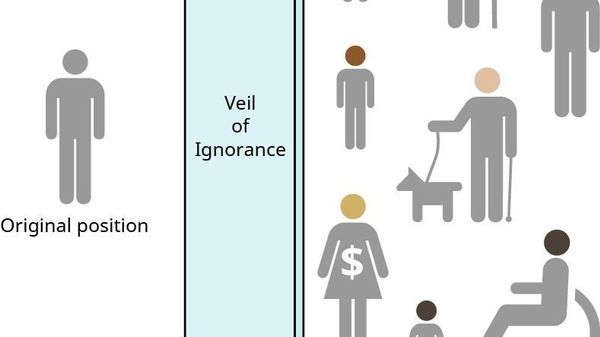
"The Veil of Ignorance" might be a useful thing to think about as we plan to lift the lockdown. The idea, associated most with American thinker John Rawls, is that, as a mental exercise and way of judging what happens in the "real world," you set about designing a social system with no foreknowledge of your own position in it.Given that "normal,"for a lot of people (as in the phrase "back to normal") was and is pretty crappy, the idea is to imagine a just economy (in terms of housing, health, cultural activity etc etc) where you and your ethnic or social group have NO guarantee of being at the top.

Most people who get to design societies, from Solon to Solomon or Jefferson to Lenin, (let alone UK civil servants) have imagined themselves to be in charge of their dream projects...because, through violence or the inherited benefits of violence, they WERE. But we live in a democracy, and in a democracy, we theoretically get to debate and agree how we want to live: what matters most and in what order.

I suggest that we are in the the "Vale of the Veil of Ignorance" right now...in that we know everything is going to change, but none of us has the first idea to what. We are getting to debate and agree on some of this stuff right now...from the explosion of food distribution charities, to clapping for carers and as we come out of lockdown, we have a limited window of choosing what we actually WANT from the New Normal, of speaking aloud the unspoken consensus we are actually already using to make decisions.

To illustrate the uncertainty personally, playwrights and others have been asking Arts Councils and government ministers for years to consciously and openly decide whether they really want a professional theatre sector in Scotland or not, and to act on that choice. Guess what? Something like that decision about whether the kind of theatre we have been making in the kind of way we've been doing it actually matters is actually GOING TO HAPPEN in the next year or so! As the Prime Mnister will no doubt learn this week, the answers to your questions may not be what you thought. I only hope my bcolleagues and I can make a better case for ourselves than he did.
Less myopically, lifting lockdown on a whole society brings, I think, an obligation to at least partially articulate the principles on which we can agree to its functioning. And that we MAKE those choices without knowing where in the new hierarchy we ourselves will end up! And if it turns out that the "new normal", is lazily indistinguishable from the rotten, corrupt old one, well, it will turn out that that is who we are, that is who we choose to be.

It may well be that this is already happening. Maybe we should be talking about it.


Monday, 24 February 2020

Postcard from London...from A Foriegn Correspondent


Scotland is SUCH a foreign country here now.  Folk here are INTERESTED in Scottish poilitics, getting vague echoes of "something going on with Nicola Sturgeon" but in the same way as they might quiz a Hungarian visitor for their views about Victor Orban.  As something happening somewhere else.  

The Union is already dissolved…but like The Death of God, this has yet to be announced officially in Church. 

For Scotland, the consequence is, paradoxically, that now, for the FIRST time, it is ONLY possible for London to rule us as a colony.  For our institutions and cultures to be politically neutered and rendered harmless to the imperial centre by means of collaborators at home and threats from elsewhere…or, alternatively,  for our relationship as EQUALS occupying areas of these islands to finally be recognised. (But given the way twerps like Toby Young still think about Ireland, let alone Kenya, I wouldn’t hold your breath, my people.)  

The strange thing is that what was once a self-serving caricature of the Union from 1707 to 2019, of the Scots as “the oppressed” rather than as “salaried employees of the oppressors” has become, accidently, a valid description.  There is NO WAY for a the Brexit Britain I am visiting to accommodate a Scotland with any degree, however limited, of political self-determination. One need only think of what a UK-EU trade deal will mean, if one is even possible at the same time as a UK-US deal with contradictory terms. Is Boris Johnson really going to undermine his precious “hostile” points based immigration system to help out hotels in Invernessshire or potato farmers in Fife?  Or fish processors in Fraserburgh?  Don’t be silly! 

You can have Brexit or you can have Devolution.  There is no way to have them both.

Brexit Britain means that the cartoon version of Scotland as an erased and colonised culture…which was bullshit till now (apart from the Gaels up till about thirty years ago)…is now going to come true for everyone who thinks of Scotland as distinct.  It may be that it was only while we were part of a Britain as an externally facing PROJECT of first, resistance to “Catholic Europe” and then an Empire and finally a Welfare State paid for out of the surplus value of international exploitation, that a Britain as an inward looking COUNTRY, as a “community” and a “culture” was coherent at all.  

The latest draft of “British” self-definition, a strange brew of John of Gaunt’s “sceptr’d Isle” and George Orwell’s “Airstrip One” so deliberately chosen when Johnson got his eighty seat majority in December, feels like entirely someone else’s business. Except that, with no reference to our distinct identity whatsoever, it is about to be imposed on us too.

The alternative, however we engineer it, is going to be some form of Independence.  Indeed, I think we will DEFINE what independence MEANS in the 21st Century (as opposed to the 19th Century version of sovereignty we blurred over in the dress rehearsal of 2014) exactly by the degree from which we can make our own path in 21st century Europe “independently” of whatever England chooses for itself in the meantime. If there has been no other achievement of the Sturgeon "era" of the SNP, (Indyref 2 before 2021 always having been a pipe dream for the birds) , then re-defining the Independence MOVEMENT as an avowedly pro-European outward facing one, then that (hopefully!) lasting achievement is, all by itself, an enormous cultural advance.  What it means to be Scottish NOW as opposed to the White Only Heather Club of  my youth, is, all by itself, a transformation we should be profoundly grateful for.

We will define our independence, I think now, unlike in 2014, NOT with reference to “Britain” or “England” primarily, but with reference to Europe and the world, as world citizens with a distinct Scottish profile which may never get acknowledged by the Toby Youngs of this world, but which may well be marked and appreciated in the much wider world beyond the London media village. 

Which APPEARS, to this visitor anyway, to be being run by an anonymous cabal of refugees from mummy’s basement with a part time and possibly alcoholic clown haired front man occasionally dragged out as a distraction.  Which is INTERESTING of course, but in the same way Victor Orban is interesting. As the chap who is unfortunately in charge of another country’s capital city I’ve had great times in, where I know some great people…but whose dilemmas…about Lisa Nandy and Kier Starmer, for example… I no longer feel I share.

Monday, 16 December 2019

Shit Got Real


Last Thursday, as the Americans say, shit got real.  That is, to be slightly more “European” about it, reality got real in a subtly different way.  History, politics, everything.

Like Scottish Independence in the months before September 18th 2014, before last Thursday, Brexit was a threat or a promise, depending on your preference. On Thursday December 12th 2019, unlike voters in Scotland in 2014, voters in England made it real.  In retrospect, it turns out to have always been clear that in order to become a real process in the UK as it already was in Brussels, it needed BOTH the mandate of the 2016 referendum and a parliamentary majority to lift leaving the EU from the category of abstraction to that of “Oh Crap, this thing is really going to happen.” For the first time in the whole process what Brexit actually means in terms of the practical management of trade, of the economy and of the politics of the Union, is actually on the table. Till now, it was a game. On Thursday, as the Americans say, shit got real.

The other shit that just got real, of course, now that the issue is done and dusted in England by the electoral will of the people…twice…once as an idea and again as a willed practical process, is that we in Scotland need to decide properly whether we’re going along for the ride. It was always the case that it was only when one piece of shit got real that we would find ourselves having to get real about the other one.

Now it’s here. What was a bad joke in 2014, that Prime Minister Boris Johnson, armed with a ten year majority,  would drag Scotland out of the EU and make devolved government a functional impossibility in the process…is no longer a half-baked threat of a worst case scenario for a No vote …it’s actually going to happen.  It’s actually already happening.  Shit, undoubtedly, got real.

Everything with which one might make a progressive case for the union, the prospect of a UK labour Government before 2030 and of meaningful federalist constitutional reform in the context of the necessary centralisation without which it is inconceivable that Brexit can happen coherently seems to be for the birds. Though it seems entirely possible this weekend that the Tories will bring forward some palliative constitutional tinkering next year in order to head off the threat of independence, I for one simply cannot see how even the limited “principle of consent” within the devolution settlements of Scotland, Northern Ireland , Wales and even London can be honoured within the context of having to make comprehensive trade deals (with the EU and the USA just for starters) that will absolutely demand renegotiations of the health and welfare markets, let alone farming, fishing and retail.  In short, I can see it being possible for Scotland to take a full part in Brexit, or to have an effective devolved government. I cannot see it having both.

The “half way house” of devolution and full participation in a Full English Brexit simply cannot live together.  We are either fully and whole heartedly on board the good ship Brexitania or we are in the lifeboat of independence. This has been the case in the abstract since 2016, of course.  But shit, as I may have said before, just got real.

One of the consequences of this altered sense of reality is that you suddenly see your own history differently.  For example, it was May 2011 when the election of a majority SNP government suddenly made the prospect of a independence referendum a really possible future event, and not just something for individual daydreams and wistful collective longing in the pub. But in retrospect, the immediate test back then was of devolution itself, not yet of independence. Would the result of a Scottish election be taken sufficiently seriously in Holyrood and Westminster for a referendum to actually happen?  That was the question then.  Up until the last few weeks of the campaign in September 2014, Scottish Independence itself seemed, like Brexit until last week, an abstraction, a threat or a promise, depending on your point of view. In practical political terms, the real priority for the Yes campaign was to ensure that the seemingly inevitable victory of No Thanks or Better Together or What You Will was not so overwhelming as to remove the threat of independence altogether for the foreseeable future.  After all, for both Labour and SNP administrations, the name of the game from the seventies onwards was to extract concessions from Westminster with the use of a prospective threat to the status quo of the British order of things, and if Indy had been defeated 70/30 as seemed entirely possible in the early days of the campaign, then Scotland as a political entity within the union might well have been fatally compromised. If anyone had offered me 55/45 at any point before August 2014, I’d have bitten both their arms off.

That result, though it was a decision not to make the Indy Shit real just for the moment, kept the leverage real…and the electoral success of the SNP since, with a wobble or two, has maintained that reality of Scotland as a political entity, a factor in the calculations of any UK government, with a majority or not.

What really makes the difference is the vote;  what England has just done. All those Labour voters who either stayed at home last Thursday or actually, unbelievably, voted for the Conservatives…have just done something very analogous to what the Scottish electorate did in 2011.  They have killed the Labour Party stone dead as a serious electoral force for the foreseeable future (though as in Scotland then, the Labour party in England, left and right,  will spend probably the next ten years in denial) and they have crucially decided that their democracy, their referendum, expressed though Brexit, is more important to them than anything.  Than Party loyalty or the Union or any other comparative abstraction. In closing one story, in “getting Brexit done”, they have knowingly opened up another door, another pathway which only seems to lead one way.

Like I’ve always said, Breaking up the Union has always been a job for the English. 

And now that Belfast has got three out of four nationalist MPs, now that Scottish voters have once again, and with a renewed sense of purpose, entrusted the SNP to navigate our way through the stormy weather to come, (can I take it that the subterranean mumbles about the SNP leadership will shoosh for a while?), we are faced in a subtly different way with defining, asserting and protecting our identity in these islands. And, as in May 2011, I would argue that here and now in the real world, the choices to be made are not yet about independence, they are once again about devolution. Is devolution a real thing or not, is Scotland at THIS moment a real entity within the UK or not. If Boris now has a real mandate for a real Brexit, can it possibly be argued that Nicola Sturgeon doesn’t have one too?

I don’t think so. I think, once the mince pies are digested, and at least SOME of the civil service can be dragged away from the all-consuming process of Brexit, that even this Tory government will settle on a consensus that, in the event of an SNP/Green…and maybe even LABOUR super majority for a second, binding Indy Ref after the elections of 2021.

And this time, unlike in 2014, the referendum will be different. This time, right from the outset, with a real possibility of winning, the real possibility of real independence will be on the ballot paper. Shit will be real next time. So everybody on all sides had best be ready. 

And despite online assertions to the contrary, I don’t think anyone on either side is nearly ready yet. Getting ready, getting all the real arguments in place for a real world future as either an independent country or a fully subsumed status as a region of Boris’s Brexit Britainnia Inc. is the real job for 2020.    

Thursday, 27 June 2019

Boris Johnson and The Ice Flow


If and when the Tory Party in England chooses Boris Johnson (or even Jeremy Hunt) as the next Prime Minister, in theory this doesn’t really change much in Scotland. In practice though, what it will tell us about England, and what it tells England about itself,  changes everything on both sides of the border.

It’s not the men themselves who will change things.  It’s not as if Boris Johnson (or even Jeremy Hunt) can instantly change either the parliamentary arithmentic on Brexit in Westminster any more than they can change the negotiating stance of the European Union.

It’s what the Tory leadership election tells us about the Tory electors that really matters…even…or especially…because “we” (the Unions of England with Scotland and with Northern Ireland) are almost wholly uninvolved except as a whiny and annoying distraction from the serious English business (or total fantasy world) of Brexit.

The only way Brexit was ever going to “work” was if it precipitated a general collapse in the institutions of the European Union.  You may have noticed that this hasn't happened, despite what its paymasters were hoping. Britain outside of the EU is still part of the European economy and is therefore bound to make a deal with the EU at some point, as long as the EU still runs that economy.

No Deal Brexot is thus as chimerical and unreal a prospect as Brexit itself has turned out to be.  What will matter in the long term, in the words of the Clash is “Something about England.” Which will in turn matter to Scotland, Ireland North and South and Wales. Not necessarily in that order.

Just as the referendum in Scotland in September 2014 changed forever who gets to make the decsions about Scotland’s constitutional future, (no matter what the outcome was) so the Brexit referendum in June 2016 changed forever how sovereignty works in England. 

Now nowhere in these islands is the Crown in Parliament Sovereign any more. We have become “Europeanised.”  The people, the electorate are sovereign.  What is more, they are sovereign in each of the four nations of the "only just United" Kingdom.

This brings us back to Boris. Just as the next Prime Minister will have a choice of accepting the Brexit terms of the annoyingly still existing EU sooner (the May Deal, backstop and all) or later…(the same only slightly worse)... so he will only really have two choices about the next general election.

He, whether it's Boris or Jeremy, will either have to call an election sooner, in order to get any version of Brexit through the Commons…or later, hoping against hope that Brexit will have been such a huge success as to ride the Tories to victory on a wave of relief and patriotic enthusiasm. 

Wherher he goes for sooner or later, the decisive factor is, of course, not Nicola Sturgeon but Nigel Farage. Either Boris or Jeremy will have to gamble that they can make such a success of Brexit that they can call an election next year having eliminated Farage as an electoral factor…or they can make a deal with him now, secretly or otherwise, and call an early election.

If I had to bet the house on one of these options, I'd bet on "sooner"...and that means that Boris will have to do a deal, publically or not, with Nigel Farage.

If that scenario seems far fetched with Jeremy Hunt as Prime Minister, to me it seems downright inevitable once Boris Johnson has his feet behind the desk in Number 10.  I would be astonished if talks between his people and Farage’s were not already well underway. 

I would also be astonished if such a prospect didn't give an almighty boost in popularity to the idea of a second Indyref in Scotland. But what else might Boris Johnson in Number Ten mean for Scotland, where, you’ll remember, sovereignty of decision on the constitution unarguably passed to the people in 2014?

I think it means two things.  First, if and when the electorate of the Tory party in England choose Boris Johnson as the next Prime Minister for Scotland, a second independence referendum becomes absolutely inevitable in the next five years.

Further, if, with or without a deal with Farage, Boris Johnson calls a general election and wins it, inevitably entirely on the back of votes in England, then the result of that referendum in Scotland is going to be very different. 

This is not because of Boris himself.  One English Tory Prime Minister more or less is not the decisive factor here. What is decisive is England’s choice  If the Tory party in England choose Boris Johnson they are consciously choosing to ignore the Union. If the English electotate subsequently confirm him as their Prime Minister, they are just as consciously voting to end it.

The beginning of the union was England’s choice.  The End of the Union will be England’s choice as well. The Independence referendum in 2021, like the devolution referendum in 1997, will be a vote to effectively ratify an End of the Union that has already happened.

(It was always thus.  It wasn't the Easter Rising itself that was fatal to the Union with Ireland in 1916.  It was the brutality with which England chose to respond to it.)

Just as Nietszche discovered with God in the 1880s, so the British people will discover in the 2020s that the Union is already dead in the hearts of our contemporaries. Indeed, the "deadness" of the wholly negative"Better Together" campaign ion 2014 was as much a clue to the condition of the corpse as the Remain campaign in 2016.

My guess...for what it ends up being worth... is that the Scottish elections in 2021 will ratify a decision to hold another referendum, with Westminster’s consent (which will be given by a new Labour or Tory administration in London) My guess for a date is September 2021…and long, boring negotiations will then begin with both London and Brussels.

Anyway at that point the hard work of redefining our relationships with the rest of these islands and with Europe will begin.  This will be a job for the next generation of Scottish political leadership, probably. 

Whether we call this inevitable change Independence or not in a few years is another question. No doubt we'll have lots of esoteric and hugely irritating fights about it. But, insosfar as such a thing is meaningful in 21st Century Europe, Independence is what it will be.

When “we lost” in 2014, history did not come a stop. The ice kept flowing. The accident of the Tory leadership contest in 2019 shows us where the ice has already reached, just like the accident of the death of John Smith did in 1994. And its direction, as I suspect he and Donald Dewar both knew, is as sure as the rise and fall of glaciers.


Monday, 11 February 2019

For Scotland, the next vote, referendum or not, is Do or Die.


https://www.theguardian.com/commentisfree/2019/feb/10/mps-peter-kyle-phil-wilson-decent-brexit-proposal?CMP=share_btn_tw A referendum POST Brexit, to confirm leaving the way that 1975 confirmed joining, seems sensible. It would also give Scotland the chance to make its own choice. This morning, I wouldn't give it a snowball's chance in a circle of hell of happening. It might, however, be the standard against which to judge which of the Nightmare Before Christmas Assortment of outcomes we're faced with at the moment, insofar as it would offer the electorates in the UK and specifically in Scotland a chance to think again.
First, obviously, do the "British People" really want to entrust their fate to Boris Johnson Globalism, when, to judge by this morning on @BBCr4today , he, like most other Leavers is actually relying on pretty much remaining when it comes right down to it. (Just as a brief aside, it strikes me, and it must strike EU negotiators, that having kept buggering on about wanting this Brexit malarkey for year after year, British politicians seem to be constitutionally unable to treat it like it anything that is actually happening...)
A post Brexit referendum at the end of transition confirming whether the UK REALLY wants to leave, would give voters in Scotland a specific challenge: Do we REALLY want to go along with whatever England does, or do we REALLY want a Scotland specific relationship with the EU?
Reflecting on the Scotland-Specific meaning a putative "Confirmatory" EU referendum in the UK would have rather forces on me the following assertion that I want to test: the next election, no matter WHAT it is, is effectively a referendum on the constitution. Without necessarily meaning to, let alone planning it, it seems to me that we have arrived at a place historically where it is inescapably the case for what we used to call "the Yes movement", including the SNP, that the next vote we get is a decisive one for that constitution. Any election we take part in has to be about the decision we make on the question of our relationships with Europe and with the UK. An existential crisis is going to happen next time we vote, like it or not.
I have never been a fan of a simple repeat exercise on the 2014 referendum and "getting it right this time." I don't think the SNP Leadership is either. This is not a source of frustration to me. A second referendum loss is far more likely than a win. But more importantly, it is a principle of history that you can NEVER stand in the same stream twice. The 2014 Indyref came out of a very special set of circimstances among the most important of which was David Cameron's rock solid certainty, (advised by Labour) that he was going to win it. As far as Cameron was concerned, Project Fear in Scotland was a rehearsal for the really IMPORTANT referendum, which was the UK one on EU membership. Many books have already been written about both calculations and both outcomes. But we MUST remember that when it came right down to it, the 2014 referendum was a Tory scheme to DESTROY the Nats...and the fact that it didn't work and that we're even TALKING about a Scotland specific response to Brexit isn't actually bad going.
More important than the simple observation that time has moved on since the first half of this decade is the equally simple observation that it has moved on a LOT, very, VERY fast...and that any prescription for what we do next predicated on a past model is likely to come unstuck.
So I return to the new premise I want to test: that the next electoral test, no matter what it is, needs to be approached by the SNP (and others of the Artists Formerly Known as the Yes Movement) as seeking a mandate for a specific Scottish relationshop with the EU. Now...this sounds terribly dry and boring and unimportant...but then, until 2016 so did the EU itself...(hence the ease of the Leave vote winning and the unreality in which Leave leaders have dwelled ever since)..and now we know it's really important to who we - Brits and Scots- ARE in the world.
For example, the Brexit process has revealed that shared EU membership was absolutely CRUCIAL to the success of devolution in Northern Ireland...and, it will soon clearly emerge, in Scotland and Wales too. At its simplest, the "return" of trade and standards regulation from Brussels to the UK...to WESTMINSTER...is an absolute bureucratic consequence of any form of Brexit, hard or soft. Brexit will centralise power in London in a way that is unthinkable in the context of devolution. All those who created and supported the devolved settlement under which Scotland has been governed for the last twenty years will very soon find that without the roader context of EU membership (for the last forty five years) devolution simply won't work.
It should be a maxim from now on: You can have Brexit or you can have Devolution: you CANNOT have both. No Tory or Labour administration of Brexit Britain will be able to tolerate the notion that somewhere in these islands, someone can do things differently. But this, of course, is where the whole project falls apart...on what was always the Achilles heel of Empire: Ireland. That failing Ireland leaving the EU on the day the UK does, just as it joined the EEC on the same day in 1973, the entire Brexit project is incoherent. Ireland will do no such thing. And, it is my contention, that the next line of defense of ANY kind of "democratic control", whatever we call it constitutionally, is for Scotland to insist on an independent relationship with the European Union.
We need to make decent trade deals that protect the identity of Scottish Branding. (Glass of British Glenlivet anyone?) We need to control the big stuff too, like immigration policy...and agriculture, tourism...Every defender of devolution knows that devolution itself is a defense against the excesses of a UK government which cannot arithmetically reflect our views on matters of health care, education policy and on and on and on...What is really historically significant about Brexit in the context of devoluition, is that Brexit will wipe that line of defence out. We will helpless in whatever breezes Boris Johnson blows whichever orifice he blows from. And THAT is what the next election, for Westminster or Holyrood or the EU is about.
The next election, whatever it is, is a question about who governs Scotland. And if, to draw a final seventies reference, the answer to the SNP is "Not you, mate"...then so be it. But make no mistake, if the SNP win the next election in Scotland, then everything must change.  


Monday, 15 October 2018

Taking the Cure


Despite the best efforts of Irish, Welsh and Scottish nationalists, the process of Breaking Up the Union of Great Britain and Ireland is a job for the English, and always has been ever since the process really got started  in Dublin in 1916. Now, by an irony of history, it turns out that our shared membership of the EU across these islands was not only the essential underpinning of the Good Friday Agreement, it was the last glue that held together the devolved Union within the island of Great Britain as well. One of the battles yet to be properly fought is over the respective roles of the devolved Parliaments in Cardiff, Edinburgh and Belfast. Meanwhile, it is of totemic importance to the DUP’s ongoing dance of glee and grievance that the Assembly in Stormont is currently shut.  That the Parliament in Holyrood has been effectively sidelined by…well, what shall we call it nowadays…the Imperial Parliament?...in London, is essential to what is laughingly still referred to as a “smooth” Brexit.

The discomfort of calling Westminster either the Imperial Parliament (of the past) or indeed the English Parliament (of the future?) points to the structural dysfunction that Brexit is newly and ruthlessly exposing. The centre, to quote Ireland’s poet of 1916, cannot hold. To misquote England’s great poet, there’s quite a lot in a name. The names we call things are what all this boorach is about.

What is as old as the hills, or as Sherwood Forest, is the insouciant ease with which the words “England” and “Britain” or “English” and “British” are still apparently regarded as comfortably interchangeable, as, unfortunately, they still are in an essay on the English roots of Brexit published last week in the London Review of Books. This lazy identification has never been possible in any of the other constituents of the Union of British Nations. For one thing, we’ve always had our own patron saints and emblematic outlaws over and above St George and Robin Hood, potent though those symbols of Englishness are. My own profoundly loyal North British grandparents were wearily familiar with the phenomenon, and always regarded a hybrid identity as both Scots and British as being intrinsic to who they were – they regarded the Scots as the Best of British - whereas George Orwell, for example, in his justly famous panegyric on Englishness, The Lion and the Unicorn, acknowledged awareness of the uncomfortableness of the identification of the English and the British for his Scottish, Welsh and Irish readers in a rather irritated footnote.

No exploration of the very English roots (and likely destination) of Brexit can even remotely come to terms with any of it actually means if it doesn’t start with the insight that all four nations are going to have to learn how to name things all over again. No matter how irritating it is that the Scots, Irish, Scots-Irish and Welsh have got a head start in adapting to a new world of multiple rather than subsumed identities.

Unionism, for example, cannot be understood unless it is understood that the same word means subtly different things in all four nations that make up that union. And that hybrid rather than merged identity has always been the syntactic rule in three of them. Englishness needs to learn how to speak its name if it is to face the world with confidence. As Antony Barnett has argued in his excellent book “The Lure of Greatness”, it is only as the European English that the English will find a future.

Britishness, like every other national identity, was a series of projects, not an essence. Starting as a Protestant bulwark against dynastic Catholic Europe, it successively evolved into a commercial Empire and a Welfare State. When it ceased to be any of these three things then it ceased being a useful way to think about what it means to live on these islands. It became a distorting mirror in which to see ourselves.

But just as in 2014, the status quo, despite appearances, is not an option on the ballot paper. Just as there was no way “back to normal” in a No vote in the Scottish referendum, the events of the past few years have permanently let the English genie out of the British Bottle.  The Brexit process, like the process of the referendum in Scotland, has shone a ruthless light on tectonic change. There is no way back to the relationship with the EU that the UK used to have, and there is no way back to what Britishness, civic or civilising, used to mean.

Brexit is only the symptom. “Britain” is now the disease that awaits a cure.


Thursday, 4 October 2018

The Last Redoubt

Bizarrely, the image that comes to mind for the politics of Brexit for the rest of 2018 comes from the Battle of Rorke's Drift in 1879. Maybe it's may age...and seeing "Zulu" on the telly on so many Sunday afternoons. 
The defence of Scotland's place in Europe is a series of redoubts...fortified positions that you have no confidence of being able to hold. But you have to do all you can to hold one position before you are forced to retreat to the next one. he first line of defense is the simplest...and yet, for many Independence activists the most troubling.  Keep the UK in the EU. You have to do everything you can by every means. In every arena. Westminster, Holyrood, the courts, public opinion. At this moment, there even seems to be the glimmer of a chance of a referendum to decide between whatever deal HMG can cobble together...
So, for me, to be logically consistent, and to take all possible allies with you, we have to wholeheartedly try that. Remember, there is no realistic expectation of the first line of defence holding...but if and when you have to retreat to the second line of defence, a vigourous attempt to hold the first defence will have helped enormously in organising allies.
Those aliies will include...and here's the tricky part for many Nationalisits...Unionists.
In the case of Scotland and Brexit, the second "redoubt" is specific to Scotland: defending the existing devolution settlement and a differential Brexit deal for Scotland...as, no matter what Arlene Foster says about blood lines...there will have to be for N Ireland and Gibraltar. Again....and again Devolution supporters who oppose Independence will have to be part of that defence.
Do you see where I'm going with this? That to make every line of defence the strongest it can be, we need everyone with us. What this means is Independence supporters doing everything they can in these first two lines of defence to bring as many allies with them as possible. And THIS means refuting the accusation of "really being interested only in independence" by making sure it is seen not be true. If we can hold the "British Redoubt" and keep all of the UK inside the EU, then that is what we should commit to do. If it is Devolution we can successfully defend then that is what we should wholly commit to do. 
I believe that if we do both of these things, without any other agenda, then when the time comes (as it probably will) to retreat to the third and last redoubt, which is seeking to rejoin the EU or EFTA and thus protecting what we have been trying to protect all along... ...then the means we need to do that, political Independence of the UK State will be self-evident and consensual...and will get support rom a lot of people who don't support it yet. 
But here's the more difficult argument to make when there's an SNP conference at the weekend...for this journey to work for the people who voted No in 2014, the SNP case must genuinely be above suspicion at each redoubt. We must be genuinely commmitted to the successive defences of the whole of the Uk...and then devolution. And if those defences hold, that has to be enough.  That's where we have to stick. This journey cannot start with independence, even if we think it probably ends there. If what we propose is Indeopendence Now...we lose everyone else. And I believe that we lose the EU...and we lose a referendum that Unionists will boycott anyway, a referndum that even if we win...we lose..
Therefore, I believe that right now, when the idea of a "confirming referendum" is current, we have not yet exhausted the "all UK" defence of Scotland's relationship with Europe. #I think the SNP needs to as near as damn it commit to that campaign. And do all we can to hold that line. I think that this means, along with a commitment to a second EU referendum...and here is where we need to take a deep breath... taking a second Independence referendum of the table if a "UK Remains in the EU" defence succeeds. 
Now, before I get shouted at...consider this. There is NO other way to persuade non-Independence supporters of a genuine commitment on our part to the aim of Remaining in Europe. Second, more importantly, the mandate for "Indyref 2" was a "material change" in ther circumstances of the UK...then that will be a material change which we will have PREVENTED from happening. 
As I say, I have no particular expectations as from week to week, the blathering chaos of Brexit gets more and more disorienting. But I want to see my representatives and my government adopt a realistic and clear posture that can hold the line and carry wide support no matter what comes next. 
I think this might be the way to do it.
Finally, whatever the next electoral test is...a general election, a second EU referendum, even the Scottish elections in 2021, the issue of Independence will be on the agenda. For me, to insist on Indyref 2 right now before anything else betrays an unjustified lack of confidence that the logic of the developing situation is entirely on our side. But if and when it comes, what is wrong with Independence being on the bais of consensus?  What is wrong with taking people who voted No in 2014 with us? 
What is wrong with a walk in the park in five years...even if we we need to be confident enough to behave a little strategically now?